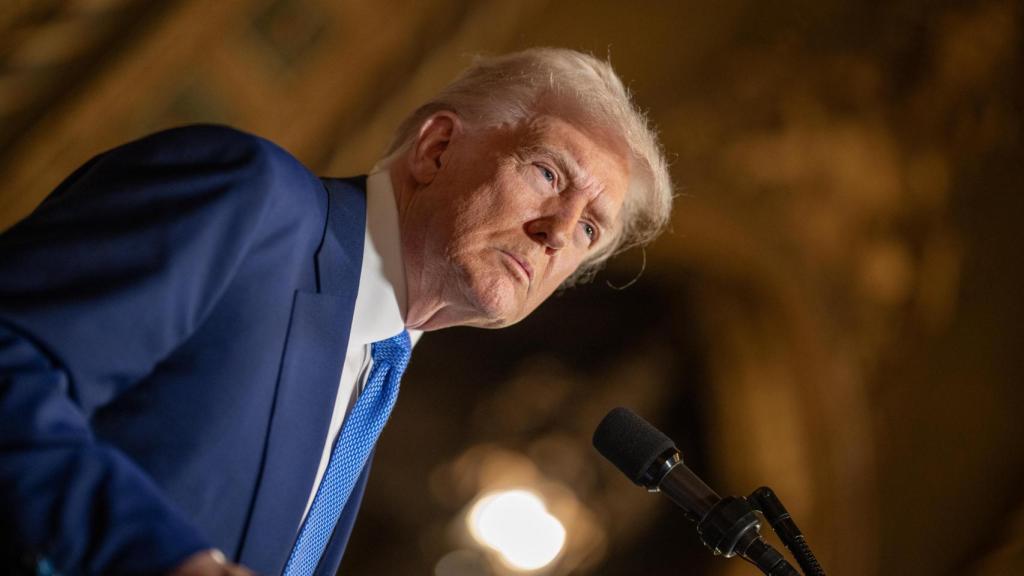
Trump refuses to call Putin "aggressor" in a G7 statement on the third anniversary of the war in Ukraine
The dispute over the planned G7 summit declaration arises after Trump referred to Zelenski as "dictator without elections".
More information: Zelenski accuses Trump of living in "disinformation": "You can't whitewash Russians as if they were money"
United States opposes categorizing Russia as an aggressor in a G7 statement on the third anniversary of Moscow's large-scale invasion of Ukraine, threatening to derail unity within this strategic group, reports The Financial Times, citing Western officials as sources.
The participation of Ukrainian president Volodymyr Zelensky in a virtual G7 summit on Monday has also not been agreed, said officials, while the office of Italian prime minister Giorgia Meloni announced they would not participate, according to FT.
This comes after U.S. president Donald Trump blamed Ukraine for the war, referred to Zelensky as a "dictator without elections", and suggested that Russia should be invited back to the G7.
The Trump administration intensified its criticism of Zelensky on Thursday, with national security advisor Mike Waltz accusing Kiev of making "unacceptable" insults to the U.S. president and demanding that Ukraine accept a mineral deal, recalls the newspaper.
The dispute over the planned G7 statement comes after Trump surprised Kiev and its European allies by contacting Russian president Vladimir Putin and authorizing bilateral talks aimed at ending the war in Ukraine.
Trump has praised Putin, accepted many of his demands regarding the war, and shown willingness to quickly normalize Washington's relations with Moscow, notes the FT.
U.S. envoys are opposing the phrase "Russian aggression" and similar wording utilized by G7 leaders since 2022 to describe the war in Ukraine, officials said.
The world's major economies traditionally issue a statement of support for Ukraine on February 24, the day Russia began its large-scale invasion three years ago.
"We are steadfast that a distinction must be made between Russia and Ukraine. They are not the same," said an official familiar with the matter to the Financial Times.

"The Americans are blocking that language, but we are still working on it and hope for an agreement."
Another American snub occurred at a planned press conference after talks between Zelensky and Keith Kellogg, Trump's special envoy for Ukraine, which was canceled upon the U.S.'s request, according to officials in Kiev.
The U.S. embassy in Kiev declined to comment, but Zelensky said he had a "good, detailed conversation" with Kellogg on Thursday. The two men discussed the situation on the battlefield, Zelensky said, "as well as effective security guarantees... We have proposed the fastest and most constructive way to achieve results."
The shift in U.S. language regarding Russia contrasts with last year when the country's aggression was mentioned five times in the G7 leaders' statement.
*This article has been automatically translated using artificial intelligence


